The electric grid is one of the greatest engineering achievements in modern history. It powers nearly every part of daily life: hospitals, homes, factories, transportation systems, communications networks, water systems, data centers and the digital economy. It is so essential, and often so reliable, that most people rarely think about it until the power goes out.
But the grid was not designed for the world now arriving at its doorstep.
Across the country, utilities are being asked to connect new loads faster, integrate distributed energy resources, harden aging infrastructure, prepare for more extreme weather, manage affordability pressure, address supply chain constraints and modernize planning processes built for a slower, more predictable era. AI-driven data center load, electrification, distributed energy resources and climate volatility are converging at once, on a clock that no prior grid transition has had to keep. The system is being asked to become more dynamic, more resilient, more digital and more flexible, while still delivering the reliability customers depend on every hour of every day.
This is the defining engineering and operational challenge of our era, and utilities are being asked to solve it on a faster clock than at any point in the system’s history.
That is why the AEIC Grid Advancement Program, powered by InnovationForce, exists.
The program is built on a simple but powerful idea: no utility should have to solve the grid modernization challenge alone. The technologies to address many of today’s problems already exist. The harder work is knowing which solutions fit which operational problems, how to evaluate them in real utility environments, how to learn from peers who may already be testing similar approaches and how to move from promising idea to practical deployment with greater speed and lower risk.
The AEIC Grid Advancement Program is designed to close that gap.
AEIC’s origin story
AEIC is uniquely positioned to lead this work because of who it is and where it comes from. As the electric utility industry’s longest-serving association, AEIC was founded in 1885 by the pioneering electric companies that helped build the modern electric power system, and it has been in the room for every major transition the grid has had to navigate since: industrial electrification, the interconnection era, the long arc of reliability engineering, the nuclear build-out, distributed generation, smart metering, and now, the data layer. Its roots are not in abstract theory. They are in practical utility operations, in shared engineering knowledge and in the hard work of keeping the power system running.
That origin story still matters.
AEIC brings together operational utility leaders and subject-matter experts, the people closest to the day-to-day realities of generation, transmission, distribution, reliability, resilience, planning and modernization. These are the leaders who understand that every new idea must eventually survive real constraints: budgets, regulation, safety, cybersecurity, workforce readiness, system integration, procurement, customer impacts and reliability obligations.
That is what makes AEIC different. It is not a forum built around innovation theater. It is a trusted, utility-led community focused on operational excellence and practical execution, the kind of peer-to-peer structure complex systems require when order and chaos are present at the same time. The industry has been here before, and collaboration is what carried it through every previous transformation.
Its motto, “Knowledge of one is the knowledge of all,” has never been more relevant.
The grid is changing too quickly for every utility to independently evaluate every technology, build every use case and learn every lesson from scratch. One utility may already have tested a wildfire situational awareness tool. Another may have worked through the data architecture needed for feeder-level load forecasting. Another may be piloting a non-wires alternative to address a capacity constraint. Another may have learned difficult lessons about cybersecurity review, vendor integration or operations.
If those lessons stay isolated, the industry moves slowly. If they are shared through a trusted, structured process, the industry can move faster.
Why this program matters now
The AEIC Grid Advancement Program begins with a clear view of the pressures utilities are facing. Utilities are not only paying for aging infrastructure. They are also meeting today’s reliability and resilience expectations while preparing for tomorrow’s digital, distributed and flexible grid. AEIC’s program materials describe this as a “trifecta” of cost pressures: yesterday’s deferred investments, today’s reliability and climate resilience needs and tomorrow’s required technologies and capabilities. These forces are placing pressure on utility budgets, customers, regulators and traditional planning frameworks.
The issue is not only physical infrastructure. It is also how utilities plan, partner, regulate and learn.
Traditional planning processes were built for a steadier future, where load growth was more predictable and infrastructure projects could be planned over long horizons. But the future now emerging is more dynamic. Load growth from data centers, electrification, electric vehicles, distributed energy resources and new industrial demand is more localized, more variable and harder to forecast. The old playbook (study, plan, build, recover costs over decades) will still be part of the answer, but it cannot be the only answer.
The future grid will require more options, better data, new operating models, new forecasting and automation and new ways to evaluate solutions that do not always look like traditional capital projects.
That is where the Grid Advancement Collaborative Program becomes essential. It gives utilities a way to modernize not only the grid, but also the process of modernization itself.
InnovationWorks as the program engine
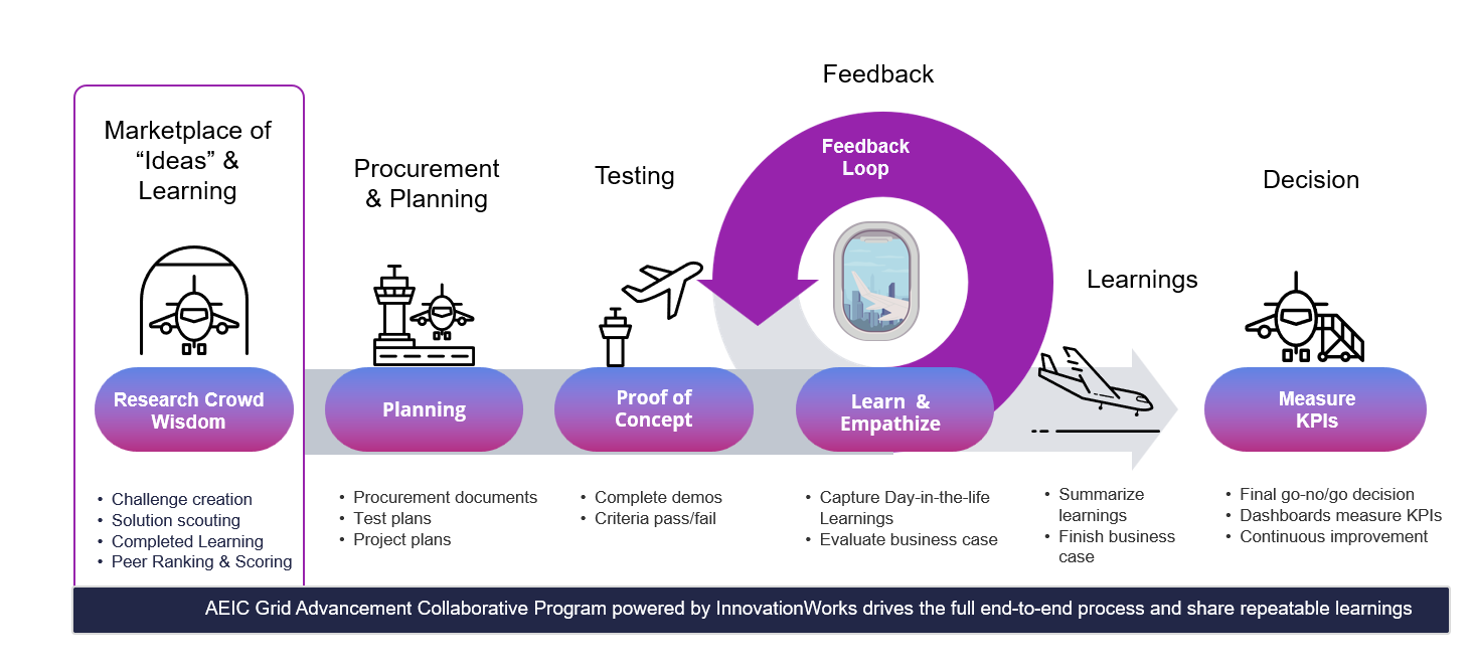
One of the most important features of the program is that it standardizes the journey from idea to action.
That may sound simple, but it is one of the biggest unlocks for utility innovation. Inside utilities, promising ideas often stall because every team evaluates them differently. A solution may be discussed at a conference, introduced by a technology partner, raised by an internal champion, or mentioned by a peer utility. But without a repeatable process, the idea can get stuck between interest and execution.
Who owns the problem? What does success look like? What data and systems does it touch? What cybersecurity review is required? What would make a pilot worth scaling?
The AEIC Grid Advancement Program turns those questions into a structured workflow.
Through challenge-specific playbooks and InnovationWorks workflows, AEIC members can move through a common process: define the Big Idea, frame the challenge statement, compare business-as-usual approaches, explore modernization solution stacks, identify potential solution providers, evaluate data and cybersecurity needs, create a test plan, gather peer feedback and prepare for a more credible pilot.
This is how the program helps members go faster with lower risk.
It does not ask utilities to move recklessly. It helps them move with discipline. It reduces the time spent reinventing the same evaluation process. It gives teams a common language. It helps peers consistently review use cases. It creates a stronger record of why an idea is worth testing, what it is expected to prove and what conditions must be in place before it can scale.
That repeatability is critical if the industry wants to move beyond isolated pilots and toward scalable modernization.
InnovationWorks, powered by InnovationForce, serves as the collaboration and workflow engine for the AEIC Grid Advancement Program. It gives AEIC members a private, structured workspace to turn shared grid modernization challenges into actionable use cases, peer-reviewed pilots and scalable learning.
That matters because utility innovation is not just about finding new technologies. It is about organizing the work required to evaluate them. A promising solution still has to clear the same bar: real data, real systems, real cybersecurity review and real operational. Ownership.
InnovationWorks helps standardize that journey and helps reduce duplicated effort. By organizing challenges around modernization solution stacks and connecting them to viable solution providers, InnovationWorks gives utilities a stronger starting point for due diligence. Members still evaluate fit, risk, cost, integration and operational readiness, but they can do so with more structure, more context and more peer insight.
An approach backed by research
One of the most valuable aspects of the AEIC Grid Advancement Program is that it treats innovation as a discipline, not a slogan.
Utilities are not short on ideas. The harder problem is creating the conditions for those ideas to be tested, challenged, adopted and scaled across complex operating environments. That is where InnovationForce adds distinctive value.
InnovationForce brings a research-informed approach through the work of its co-founder, Dr. Linda A. Hill of Harvard Business School. Her recent book, "Genius at Scale", focuses on how leaders create the conditions for innovation to scale across complex organizations. That is precisely the problem utilities face every time a promising pilot fails to move beyond a single operating area.
Every challenge playbook starts with a modernization solution stack
A defining feature of the program is its use of challenge-specific modernization “solution stacks.” Each playbook begins by looking honestly at the business-as-usual approach, then broadens the field of possible solutions.
This is important because many utility challenges are currently addressed through familiar tools that remain necessary but may no longer be sufficient on their own. The program does not dismiss traditional infrastructure investment. It reframes it as one part of a broader portfolio.
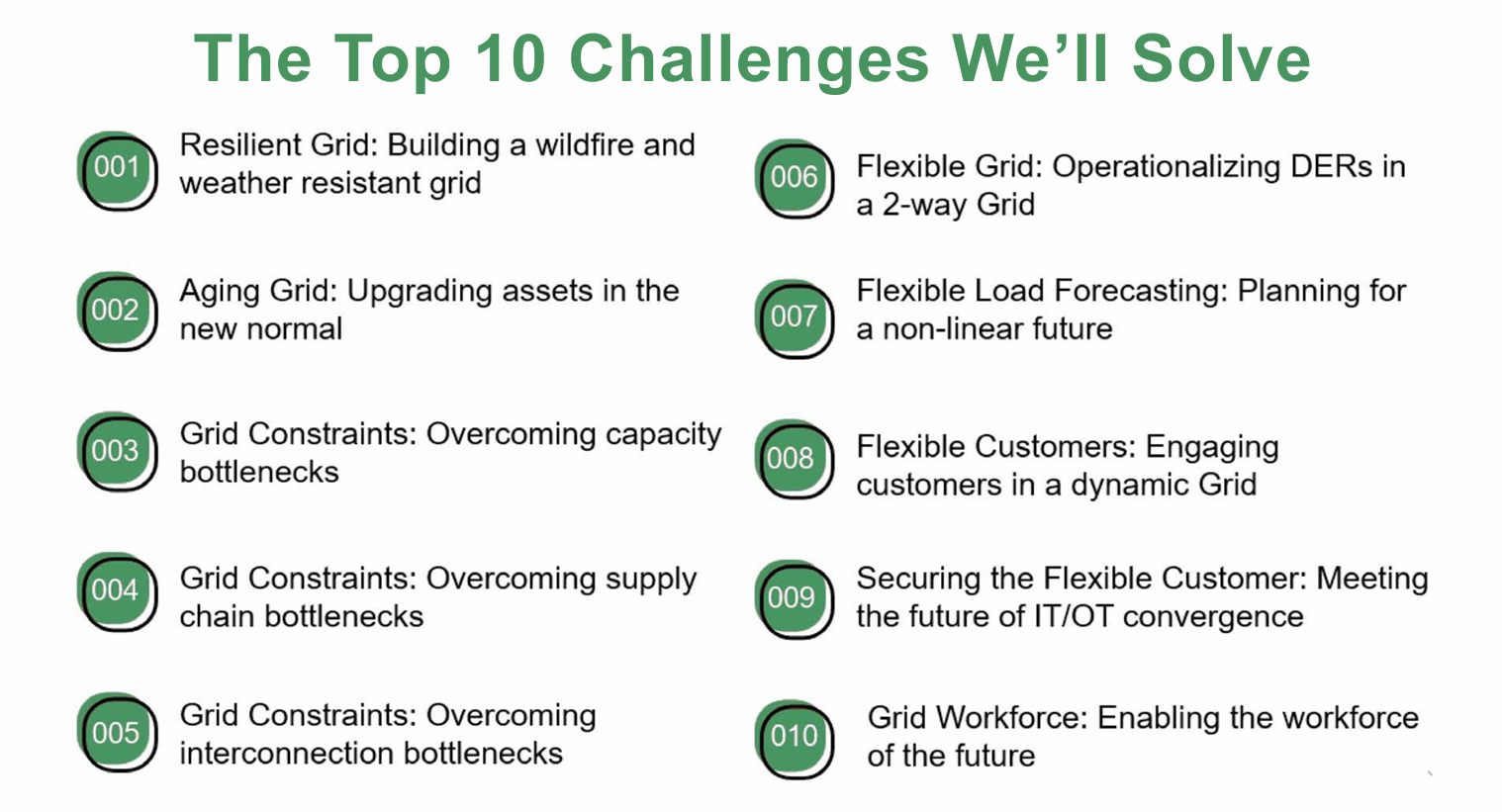
The pattern repeats across the program’s priority challenges. For weather and wildfire resilience, undergrounding and pole hardening sit alongside situational awareness, sensors, predictive analytics and data-driven response. For load forecasting, deterministic models sit alongside probabilistic forecasting, real-time DER visibility and adaptive planning. For capacity constraints, a feeder or substation upgrade sits alongside non-wires alternatives, managed EV charging, virtual power plants and customer flexibility programs. For interconnection, the large transmission build sits alongside advanced reconductoring, dynamic line ratings, flow-control technologies and storage-as-transmission. In none of these areas does the modernization layer replace the traditional approach. It expands the set of viable options.
This solution-stack approach helps utilities ask better questions. Instead of defaulting to, “Which capital project should we build?” teams can ask, “What combination of physical infrastructure, software, data, automation, operational changes and customer-side resources can solve this problem at the right speed, cost and risk level?”
That is a fundamentally more modern way to plan.
Data readiness as a modernization requirement
Another strength of the program is that it treats data readiness as central to grid modernization.
Many new solutions depend on data that may be fragmented across the organization. A forecasting use case may require AMI interval data, SCADA data, GIS models, customer information, DER interconnection records, weather data, EV adoption information and feeder or transformer loading. A resilience use case may require asset data, outage history, weather feeds, vegetation data, field inspection records and operational telemetry. A capacity or flexibility use case may require customer load shapes, program participation data, DER visibility and operational constraints.
These data sources often sit in different systems, owned by different teams, governed by different processes. If those issues are discovered late, pilots slow down or fail. The AEIC playbooks and InnovationWorks workflows encourage teams to identify data needs, governance gaps and cybersecurity considerations early.
That is another way the program lowers risk. It brings hidden implementation issues to the surface before a utility has already committed major resources.
In the modern grid, data is not a side issue. It is part of the infrastructure of decision-making. Utilities that can organize, govern and apply data effectively will be better positioned to forecast load, integrate DERs, evaluate non-wires alternatives, improve resilience and operate a more flexible grid.
A movement led by operators
The AEIC Grid Advancement Program is powerful because it is led by the people who understand the grid best: operational leaders and subject-matter experts responsible for keeping the system safe, reliable, resilient and affordable every day.
That gives the program credibility. It also gives it urgency.
The future grid will not be built by technology alone. It will be built by the operators who know how to translate technology into utility practice, the same people AEIC has put in the same room for more than a century. It will require planners, operators, engineers, IT teams, cybersecurity experts, procurement leaders, customer teams, regulators and solution providers to work in new ways. It will require governed environments to test ideas, shared methods to evaluate them and trusted networks to accelerate learning.
The AEIC Grid Advancement Program provides that space.
It is a deliberate move away from isolated pilots and endless scouting, toward shared discipline that creates lower-risk, higher-impact modernization portfolios more affordably.
The grid modernization challenge is too large for any single utility to solve on its own. Together, utilities can move at the pace this transformation actually demands. That has been the AEIC pattern for 140 years. This program is its current chapter. Learn more about the program, watch the latest videos or download challenge playbooks by visiting the AEIC Center for Operational Excellence website.

Dr. Elizabeth Cook is vice president of Technical Strategy at the Association of Edison Illuminating Companies (AEIC) and program director for the Center for Operational Excellence, where she leads AEIC's grid modernization, workforce and AI fluency programs. A national leader in grid modernization and operational transformation, she hosts the Grid Mod Pod, AEIC's weekly podcast where utility voices share with utility voices.
Cook serves on the board of the Energy Systems Integration Group (ESIG), is an adjunct professor at Carnegie Mellon University and was previously director of Advanced Grid Systems at Duquesne Light. She holds a Ph.D. in electrical and computer engineering from the University of Pittsburgh.
Outside her AEIC work, she runs an advisory and leadership coaching practice and is the founder of Integrated Being, where she writes and hosts the Integrated Being podcast on mind-body-spirit connection and intentional living.