With energy demand increasing, traditional fossil fuel assets phasing out and security risks growing, Virtual Power Plants (VPPs) are becoming an increasingly important tool to facilitate the global energy transition.
VPPs are connected systems of distributed energy resources – like solar, batteries and generators – capable of supplying power to the grid. They can play a critical role in supporting future energy growth and infrastructure security by providing gigawatts of clean energy capacity during emergencies and periods of high demand.
As outlined in a new report from IEEE Power & Energy Society (PES), Virtual Power Plants: A Critical Assessment of Their Role in Energy Security, VPPs are an invaluable tool that grid operators and regulators should deploy at scale over the next decade. It’s not a one-size-fits-all solution, but it will make significant progress in increasing all energy capacity and mitigating grid security challenges.
VPPs also help improve grid reliability by reducing the need for traditional power-generating infrastructure, which can take years and require a significant investment to deploy. In fact, pilot programs in the U.S., Australia and New Zealand have shown that VPPs can be reliably dispatched to support the grid during periods of highest risk.
For example, Pacific Gas & Electric (PG&E) and Sunrun launched a first-of-its-kind residential battery VPP pilot in Northern California in response to California’s record heat waves earlier this decade. By the summer of 2023, the VPP provided an average of 27 MW of dispatchable capacity during peak hours for over 90 consecutive days, offering a dependable daily resource to the grid that became operational only six months after the contract was signed.
The case for VPPs
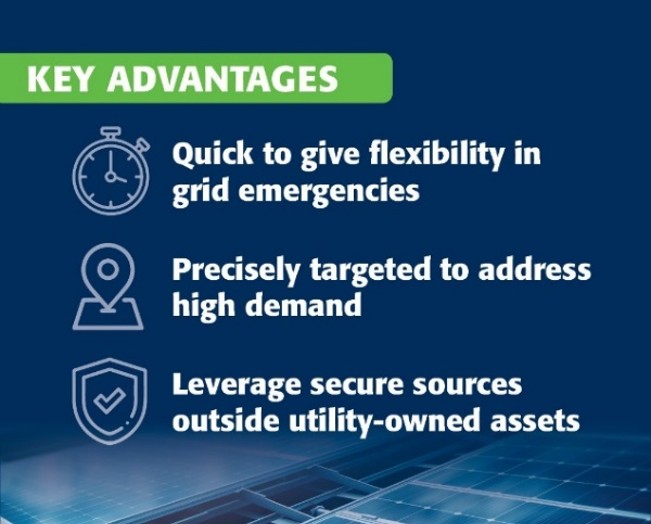
VPPs are an optimal solution in times of crisis and high demand. Whereas traditional power-generating assets are cumbersome to build, costly to operationalize and can take years to be energized, VPPs can be stood up in far less time and are highly responsive to grid emergencies, as PG&E and Sunrun have shown so far in their pilot program.
VPPs should not be deployed as all-purpose grid resources, but as high-value, fast-response capacity for peak and emergency conditions.
What’s more, VPPs can also provide energy to targeted geographic areas, enabling them to address demand where needs and volatility are highest. It is also worth noting that VPPs mitigate growing security concerns because they leverage reliable, controllable assets behind the meter. It’s clear that the growth of VPPs can help provide resiliency and security to the electric grid. However, to better enable VPPs as an option during emergencies and moments of high risk, grid operators and regulators must focus on a series of goals to improve connections and reform market incentives to increase overall VPP adoption.
Goal #1: Meet short-term grid security & capacity needs
Grid operators and regulators must ensure VPPs can be utilized at scale during emergencies or when demand surpasses supply. To better prepare for these security and capacity needs, it’s critical that grid operators and regulators create incentive programs that are best suited for the functions of VPPs. Doing this will encourage more utility operators and consumers to participate, as was evident in the Southern California Edison VPP pilot with Tesla.
The program began with volunteer Tesla Powerwall owners in 2021, but it saw substantial growth in participation when it began offering $2 per kWh payments for energy fed into the grid during emergencies. By 2023, the VPP exceeded 100 MW of aggregate capable capacity, a milestone that shows just how quickly these programs can scale when incentives are aligned.
In the immediate term, decision-makers should also lower the barriers to adoption in ancillary service markets, making participation more accessible. And finally, they should require utilities to run transparent procurement processes with full consideration for how VPPs can replace infrastructure upgrades and save ratepayers money.
Goal #2: Provide long-term security & meet capacity strains more reliably
To ensure VPPs can meet non-negotiable reliability and security needs, operators and regulators will need to take even bolder actions. For one, they should reserve capacity for critical grid needs by locking in “must-run” support via long-term contracts. It’s also critical that the energy generated by VPPs is sold to other providers only when it's not already committed to improving reliability service.
Lastly, basing payments on the amount of energy flowing in and out will provide a clear view of the value each VPP contributes to the grid. SolarZero’s VPP pilot in New Zealand, detailed in the IEEE PES Technical Report, demonstrated that VPPs can deliver measurable value, but capturing that value at scale requires systemic changes beyond individual pilots.
Goal #3: Build more VPP-connected grids
To allow for VPPs to expand systemwide and meet current and future energy needs, regulators should take three additional actions.
- First, they should mandate foundational infrastructure upgrades that encourage advancement by setting clear, enforceable deadlines to install smart technology and build new processes.
- Second, to further integrate VPPs into grid operations, regulators should incentivize innovation to motivate utilities to embrace and deploy the technology.
- Finally, regulations should be set that drive interoperability by referencing open standards and making compliance a condition for utility cost recovery or program funding.
What’s next?
Adopting VPPs is a critical piece of the global energy transition. Deploying the technology at scale will help address growing demand and strengthen energy security, but this will only happen with collaborative action among grid operators, regulators and utilities.
Taking concrete steps together to support VPP growth will help bridge the demand gap and chart a clear path forward as we navigate the next decade of energy and beyond.
About IEEE Power & Energy Society (PES)
The IEEE Power & Energy Society (PES) is the leading provider of scientific and engineering information on electric power & energy for the betterment of society and a trusted resource dedicated to the technical, informational, networking and professional development needs of its members. With nearly 40,000 members around the globe representing every facet of the electric power and energy industry, PES is at the forefront of the rapidly changing technological advancements that impact everyone’s future. Additional information on IEEE PES can be found at ieee-pes.org.

With more than a decade of experience in power systems and smart grid innovation, Dr. Shikhar Pandey is principal at Grid CoGroup and has held senior leadership roles at Commonwealth Edison, where he led distributed energy resource planning, storm performance analytics and regulatory strategy. He holds a Ph.D. in power systems and an MBA from the University of Chicago Booth School of Business. He currently serves as chair of the IEEE Task Forces on Distribution Resiliency and Grid Flexibility and as the secretary of the IEEE Industrial Technical Support Leadership Committee (ITSLC).