The rapid growth of renewables and ambitious commitments in line with the global goal to triple renewable power by 2030 are exposing a critical skills gap. Although renewable energy jobs are growing from 16.2 million in 2023 to 16.6 million 2024 employers are reporting increasing difficulty finding experts to fill key vacancies, especially in technical trades such as installation and repair, but also in fast-evolving fields like digitalisation and artificial intelligence in energy systems.
Acute skills shortages could constrain renewable energy deployment, effecting the pace of energy transition, economic competitiveness and sustainable development opportunities. Closing the skills gaps necessitates urgent action and investment to scale up workforce development and build resilient supply chains. Building a robust enabling environment also requires targeted skill development in areas such as energy governance , finance, business, law, education and community development.
Accelerating skilling for the energy transition is not an easy feat and must not be done in silos.
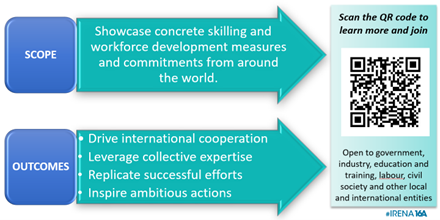
To that end, the International Renewable Energy Agency (IRENA) is taking an initiative through the Call to Action on Skilling for the Energy Transition. The Call to Action seeks to drive international cooperation on education and training for a sustainable energy future. With the Call to Action, IRENA is currently inviting governments, industries, education, labour, civil society and other local and international entities, to share concrete measures and commitments to accelerate domestic and global skilling for the energy transition.
During a dedicated session at IRENA's 16th Pre-Assembly earlier this month, IRENA presented the measures and commitments already contributed through the Call to Action thus far. Ranging from national and local institutions, to industry associations, education and training providers, as well as international organisations, the contributions include the following:
- Global Wind Organisation - training standards and frameworks for the industry that can serve as a valuable resource for training.
- Global Solar Council - workforce development for the solar sector and is currently developing Global Solar Training Standards.
- European Training Foundation - works to align vocational qualifications and curricula with industry needs.
- International Labour Organization (ILO) - works to strengthen national systems to support skills development.
- The Renewables Academy - provides technical expertise or exchange of practice and resources, to other countries and institutions that are seeking to accelerate skill development.
- Student Energy - works to build the capacity of youth ages 18-30 including through training and mentorship, job placement, and support for youth-led innovation.
- International Finance Corporation - supports women's access to jobs and entrepreneurship opportunities in Africa under Mission 300.
- The African Energy Commission and the United Nations Economic and Social Commission for Western Asia - provide technical expertise and capacity building.
- GNCORP in Australia - supports inclusive workforce development and measures to include people with disabilities within the renewables workforce.
Echoing the sentiments of those present at the session, Ms. Olga Strietska-Ilina, Head of Future Skills Unit, ILO, said during her intervention, "This endeavour certainly fits with the ILO mandate, and we are happy to be part of the discussion. We will therefore continue to support the Call to Action. We can have more synergies with ILO's activities and make sure the energy transition has the skills and capacity needed."
Join the Call to Action on Skilling
For more information

336 East 45th Street, 11th Floor
New York New York
United States 10017
www.irena.org