The paths of female executives in the energy industry are as unique as the women themselves. Some arrive by accident, some through their knowledge of math and science and others by a mix of both. For Christina Knowles, her passion for engineering and manufacturing, combined with her ability to navigate through the complexities of the utility sector, is what led her to a meaningful career in an industry she considers impactful.
“The space is always growing and evolving, and I was drawn to that,” Knowles explains. “The fast-paced growth and the complicated ways that our product is engineered to match a customer’s needs. I thought it was really interesting, and it played to that engineering part of my brain.”
Knowles, who is vice president of North American Operations at G&W Electric, has been with the company for nearly 15 years. She has served in her current role for the past three years.
From Michigan to G&W Electric
Knowles studied engineering at Kettering University in Michigan, where, like many engineering programs, the majority of students were men. She began her career as a co-op student at General Motors, where she completed engineering and manufacturing rotations. After graduating in 2007, she found herself at a turning point.
“The trajectory of the auto industry at that time was unclear. I left Michigan for a job in Illinois, working for a manufacturer of water filtration equipment,” she says.
She recalls her first impression of G&W Electric when she visited it in 2011. “At the time I started at G&W Electric, the company was a small, privately held manufacturing company based in Blue Island, IL. It was very high-mix, low-volume, and the products were engineered to order for the energy industry, and that industry and family-oriented company caught my attention.”
Problem-solving
Knowles’ first project at G&W Electric was working with their Viper Recloser product line, where the goal was to double the product line’s capacity. Looking at what seemed a tall order then, Knowles says that today, G&W Electric is managing 10 to 12 times more than what her team was trying to do then.
Earlier in her career, Knowles took on opportunities that required significant personal investment, including relocating her family. “When my children were young, we moved to our Toronto plant as part of an expansion and acquisition,” she recalls. Facing that challenge helped set the foundation for what I came back to in Bolingbrook, expanding into different product lines, different buildings and different countries.
Experience as a foundation
Over time, Knowles has seen how early challenges often become the groundwork for future success. “When you look back, the things that once felt like the toughest hurdles often turn out to be the most valuable,” she explains. “The effort you put in then becomes the foundation you build on later, giving you the baseline to take on the next set of challenges.”
What excites Knowles most about her work is its ever-changing nature. “We have some of the most complex problems to solve for our industry that have ever existed,” she says. “Growth in the industry is exciting — it’s something that everybody uses. I work on the operation side of things, so it’s about scaling for that growth, managing the complexity of our make-to-order business and satisfying all the various utility companies and C&I customers that have constantly changing needs.
Any time she speaks with job applicants, Knowles underscores the dynamic pace of the work. “When I talk to prospective employees, I emphasize that no two days are the same. There’s an interesting blend of strategy, day-to-day floor leadership, continuous improvement and solving technical challenges that come up with building custom products. That’s what makes it fun.”
Industry challenges: The 3Ds
As the industry evolves, Knowles sees the biggest challenges framed through what G&W Electric calls the “3D Model.”
“One of our VPs of marketing put together a model that I find resonates: the 3D model — decarbonization, decentralization, and digitalization. I’m more operations-focused, but that model helps bucket the complexity.”
Expanding on that idea, Knowles explains that these forces reflect a broader shift toward grid modernization and energy resilience across the global power sector.
“Our demand for power is skyrocketing. We are under pressure to shift to cleaner energy sources, manage a multidirectional grid and harden infrastructure against storms, fires and other challenges — with AI, data sets and electrification — all layered on top. The challenge is building a smart, resilient grid, but the pace is what makes it most challenging. It ties back to manufacturing: we’re constantly working on growth and capacity, just scaled up to the industry level.”
Growth and culture
From 150 employees when Knowles started to just under 1,900 today, G&W Electric’s expansion has been dramatic. “When you think about 150 employees versus 1,900, the culture hasn’t changed, per se. The ownership and values have been consistent. But the complexity in which we navigate has changed. We’ve had to become more nimble, maintain that culture across borders and keep the family feel,” she says.
“Before COVID, we had quarterly town halls where everyone would hear directly from the owner and executive leadership. We’ve restarted those globally. Employee recognition, connection points between sites — all of it matters. Being privately held gives us one consistent voice, which makes a difference.”
Trends and transformation
Describing the industry trends she feels we should pay attention to, Knowles says her expertise goes more into the internal side of operations. “I think on the internal operations side of things, the same trends we see across the industry are shaping what we do as well. Things like digital transformation and the need for real-time data monitoring and analytics — whether it’s inside our factories or on the grid — the need is the same, and the trend is the same.
Of course, there’s the universal push for more, better, and faster — that will always be the case. It’s just happening at a faster pace than it used to. But that technology, that reshaping of the grid, it’s not just changing the grid itself — it’s reshaping how we design, how we build, and how we deliver our products.”
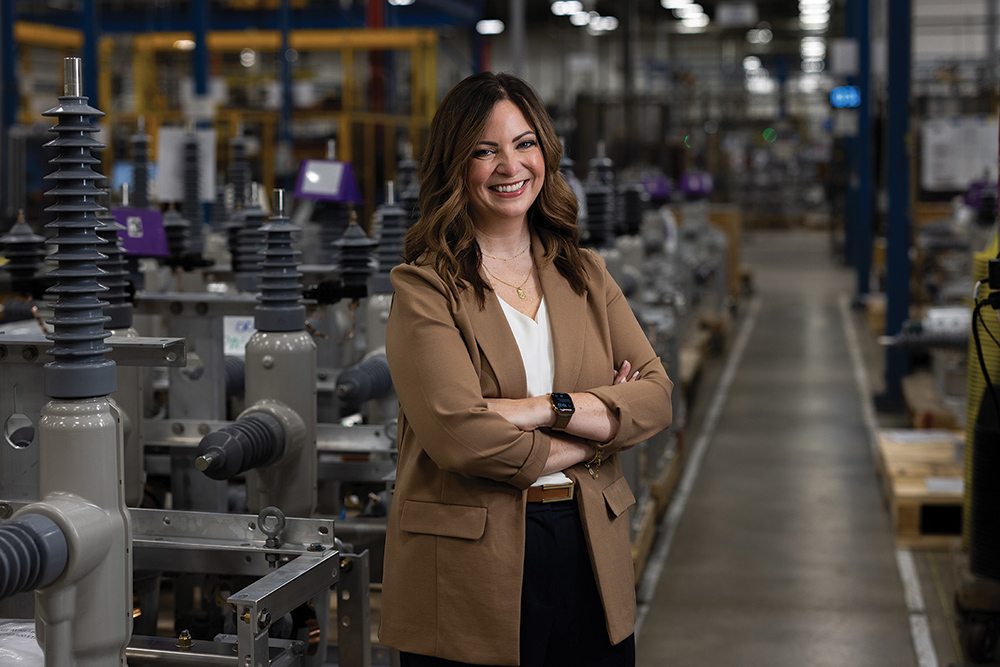
Christina Knowles in Plant 1. Source: G&W Electric
Inspiration and diversity
Inspiration, for Knowles, often comes from the shop floor. “I love going out on the shop floor,” says Knowles. “Our employees are proud of the work they do, and it shows. Every product has a customer name on it — it’s engineered to order. Employees know which design they’re working on and the utility it serves. That’s both unique and very cool.”
Knowles also emphasizes the role of diversity in driving success. “The best ideas come from teams that don’t all think the same way. Our leadership team is roughly 50% women, which is notable in an industry where women are underrepresented. Diversity of thought drives better outcomes. These voices matter, whether in a boardroom, on the factory floor or out in the field. We embrace that, and it makes the industry stronger.
“Everything I just said applies regardless of industry or background. To serve the public, you need people who understand different perspectives. Limiting diversity limits outcomes.”

With nearly 15 years at G&W Electric, Christina Knowles has seen firsthand how growth, technology, and resilience shape the future of the energy industry. From doubling production capacity to leading teams through rapid expansion, she has helped steer the company’s operations through transformation while maintaining a strong, people-centered culture. Her work reflects both the evolving landscape of modern utilities and the leadership required to keep pace with it.